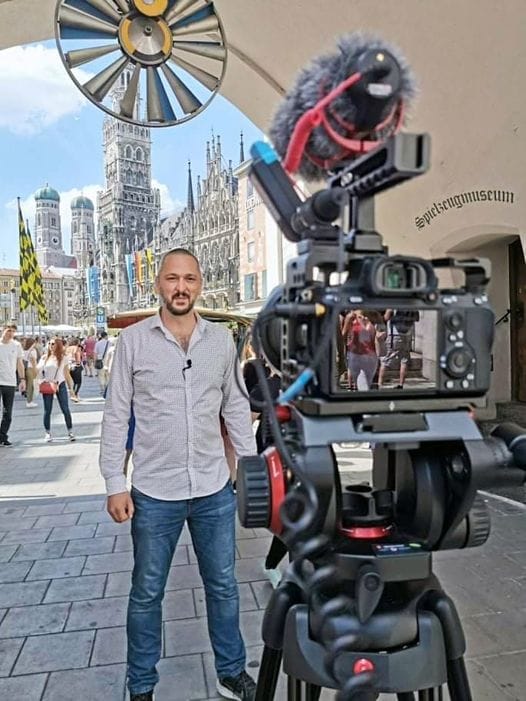
Diplomatic International Journalist
editor at digital magazine
rEUconnection – REUC
Born into a family where music was second nature and nurtured by the rich harmonies of gospel in his hometown church, Stanley Jackson’s voice has traveled far — from musicals in American high schools to the grand stages of European opera houses. In this exclusive interview, Jackson opens up about the early spark that ignited his passion, the mentors who saw his promise, and the realities he faced as a Black tenor navigating the professional opera world.

With a voice that bridges continents and a repertoire that spans centuries, Stanley Jackson stands as one of the most versatile and compelling tenors of his generation. Born in St. Louis, Missouri, and trained at the University of Missouri-Kansas City, Jackson’s journey from American opera houses to European stages is a testament to both talent and tenacity.
With rare candor, he reflects on moments of triumph and tension — including his decision to pursue his career in Europe, his refusal to be stereotyped by race, and the personal fulfillment of singing Gluck’s Orphée et Eurydice, a role that mirrors the emotional terrain of his own life.
Even today, though he sings less frequently, Jackson remains deeply engaged with music, committed to finesse over force, and devoted to the timeless beauty of French repertoire. Whether performing in small venues or planning new recordings, his artistic fire still burns — quietly, passionately, and unapologetically.

Stanley Jackson is not simply a tenor. He is a voice with history, heart, and a story worth listening to.
His early career was shaped by prestigious Young Artist Programs, including the Lyric Opera of Chicago, Santa Fe Opera, and Opera Theater of St. Louis. But it was in Europe—at the Nationaltheater Mannheim and Opera Leipzig—where Jackson truly flourished, taking on roles such as Tamino (Die Zauberflöte), Don Ottavio (Don Giovanni), and Nemorino (L’elisir d’amore).

Critics have praised his lyrical sensitivity and dramatic depth, whether portraying Lenski in Eugene Onegin or Orphée in Gluck’s Orphée et Eurydice. His performances in Les Troyens, Theodora, and Scott Joplin’s Treemonisha reveal a tenor unafraid to explore both the classical canon and contemporary works.
Jackson is also a recipient of multiple vocal awards, including the Metropolitan Opera Awards and the Liederkranz Foundation First Prize—further proof of his artistry and vocal excellence.
As we sit down with Stanley Jackson, we explore not just the voice, but the vision behind it: a tenor who sings with soul, thinks with curiosity, and performs with purpose.

Interview
Journalist: What first drew you to the world of opera, and how did it shape your artistic journey?
Stanley Jackson: „Very good question. I started singing at home with my family—everyone sang—and in church, where I was immersed in gospel music. That experience gave me the singing “bug.” I eventually began taking lessons and discovered that I had a real voice.
In high school, I auditioned for a musical called Bells Are Ringing—originally starring Dean Martin and Judy Holliday. The audition had already ended when I approached the music teacher, Miss Brown, but she allowed me to audition anyway. She saw something in me and cast me as the lead. It was a big success. Miss Brown became my mentor and encouraged me to study voice more seriously because she recognized my vocal talent.
That was the beginning of a lifelong journey of voice training—which, by the way, never truly ends. I went on to become a successful operatic tenor, performing throughout Europe.„

Journalist: Can you reflect on the challenges you faced transitioning from the Academy to establishing yourself as a professional opera singer?
Stanley Jackson: „During college, I felt relatively safe and truly enjoyed my time there. I was deeply committed to excellence and focused on achieving my goals. I did experience a few instances of racism, but I brushed them off.
However, the professional world was a different story. I faced more explicit discrimination, particularly during my time in the Young Artist Program at the Lyric Opera of Chicago—one of the top programs of its kind. I had a candid conversation with someone high up in the administration who told me, frankly, that I should start my career in Germany.
He explained that in the U.S., the arts in are funded largely by wealthy, older white men, many of whom were uncomfortable seeing a Black tenor in a romantic role opposite a white soprano. It was not something they were willing to fund. That was a hard truth to accept at the time. Thankfully, the situation has improved, and today there are more successful Black tenors singing in the top opera houses across the U.S. But that wasn’t the case when I was starting out.
So, I took his advice. I got an offer to replace a tenor friend in a production in France. From there, I met my soprano friend Marrisol Montalvo, who invited me to stay with her in Germany—and that was the beginning of my European career.„

Journalist: How did your personal convictions about race and representation shape your decision to pursue an operatic career in Germany, and influence the roles you chose to perform?
Stanley Jackson: „The role that has brought me the deepest artistic fulfillment is Orphée in Orphée et Eurydice by Christoph Willibald Gluck. I love the story—it explores themes of love, loss, grief, and the struggle to overcome adversity. These are themes I’ve had to confront throughout my life, so I feel a deep connection to this opera.
The music is also beautifully written for the tenor voice. The tessitura is high, but it suits my voice perfectly. I recently sang through it again and was pleased to find that I can still sing it. That’s a testament to good vocal technique.„
Journalist: You stepped away from your career for a period—how did that experience shape you, and how do you sustain the excellence of your vocal artistry?
Stanley Jackson: „I had to step away, like many singers, because of the pandemic. I’m not singing at the same level as before, but I am still practicing with the goal of returning to my passion. I believe I will return because the passion is still very much alive in me.„

Journalist: How would you assess the state of classical music and opera today? Has the art form evolved in ways that inspire or challenge you?
Stanley Jackson: „Honestly, I believe the art form has declined. I used to think it was just happening in Germany, but I’ve seen the same trend in the United States and elsewhere. Many singers today focus on volume over finesse. There are great singers out there—don’t get me wrong—but the emphasis on Bel Canto, healthy singing, and beauty of line seems to be fading.
My teacher, Inci Bashar—who’s been my teacher for what feels like 100 years, haha—is still advocating for this approach: singing with finesse and patience, not force, but on the interest of the voice. It’s not just about talent. Yes, talent is necessary—but it’s also about tenacity. You must have guts and never give up.„

Journalist: Do you envision a full-scale return to the operatic stage, and if so, what might that look like?
Stanley Jackson: „Not really. I’m no longer actively pursuing opera roles. However, if I had the chance to sing Orphée et Eurydice again, I would definitely do it. For now, I’m more focused on recital and concert.

Journalist: Is there a particular composition that, at this moment, resonates with you most deeply as an artist?
Stanley Jackson: „I love singing French music. My voice is especially well suited for the French repertoire—Fauré, Debussy, Bizet, and so on.„
Journalist: When can audiences next experience the beauty and power of your voice?
Stanley Jackson: „Right now, I’m working on the possibility of recording a duet album with my dear friend, Eleni Matos. We’re currently searching for funding. In the meantime, I’m singing in small venues to keep my performance skills sharp.„
Daj svoj stav!
Još nema komentara. Napiši prvi.