
multiple award-winning journalist
and documentary filmmaker – Kosovo
For over two months, prominent lawyer Arianit Koci has been holding solo protests in Pristina, raising his voice against Kosovo’s ongoing political deadlock. Last week, in a powerful symbolic act, four donkeys appeared in front of the Parliament building an image Koci used to denounce what he describes as the apathy and detachment of the country’s political leaders.
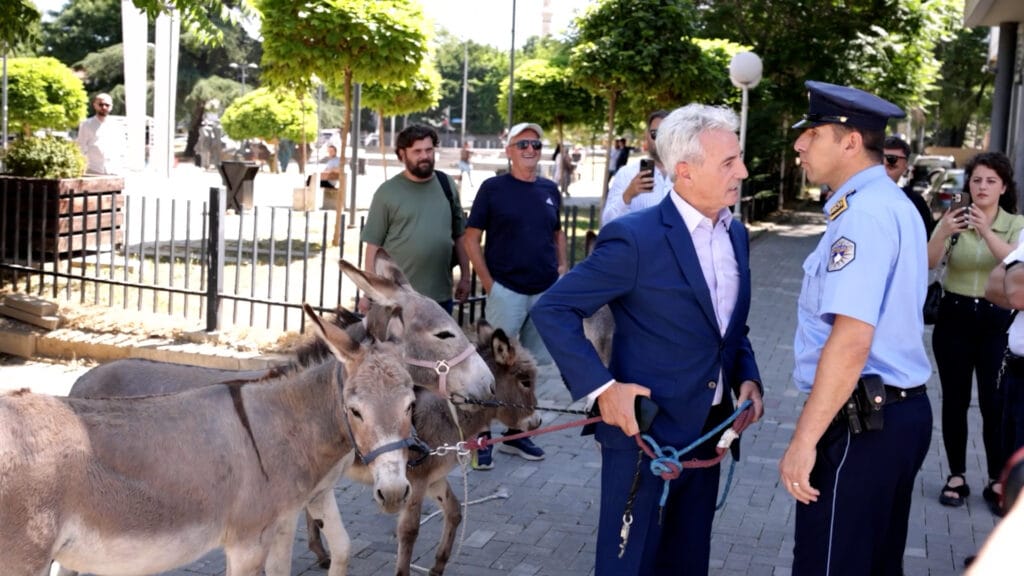
PRISTINA — The political stalemate in Kosovo shows no sign of resolution. For the 41st consecutive attempt, the newly elected Parliament has failed to hold its inaugural session. In a symbolic protest reflecting the growing public frustration, prominent lawyer Arianit Koci arrived at the gates of Parliament with four donkeys — a visual metaphor, he says, for the stubbornness of the political class. He will also protest on Sunday alone.
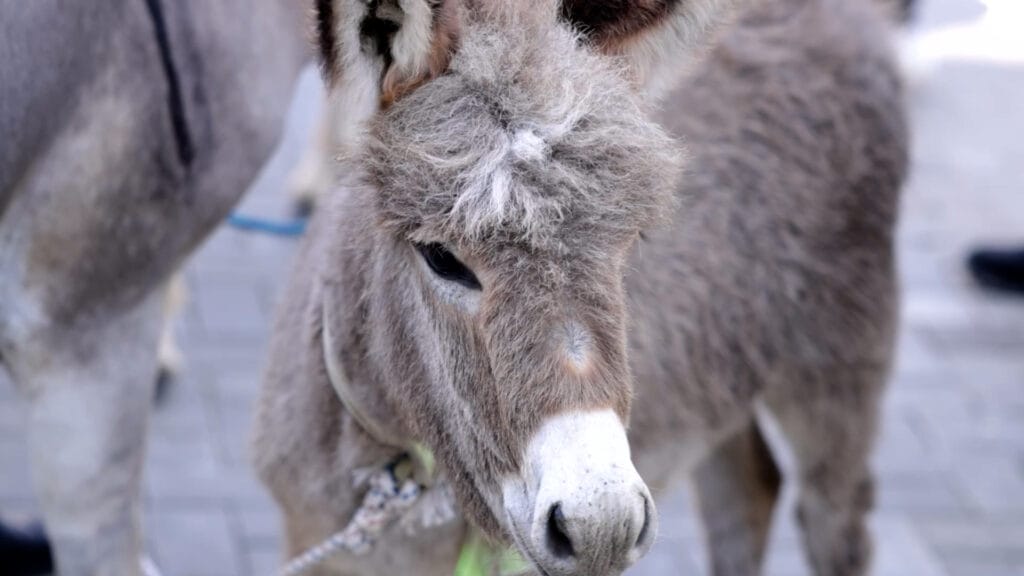
“I think it’s clear why I’m protesting,” Koci told journalists outside the building. “Our MPs have failed to reach an agreement in 41 sessions. Parliament is paralyzed, and the country is losing huge amounts of money. I chose donkeys because they symbolize the obstinacy and hard-headedness of our deputies they behave just like donkeys.”

According to DW reports for the past four months, Kosovo’s political parties have failed to form a government. No party has been willing to compromise, despite the urgency of the situation. The ruling Vetëvendosje (VV) party, led by acting Prime Minister Albin Kurti, secured over 40% of the vote — a strong showing, but not enough for a majority. Kurti nominated Albulena Haxhiu as Speaker of Parliament, but opposition parties refuse to support her candidacy, arguing she is unfit for the position.
Opposition holds its ground
Paris Guri, an MP from the Democratic League of Kosovo (LDK), emphasized the party’s firm stance. “We will not support any candidate who fails to secure the necessary 61 votes to be elected. The Constitution gives the leading party the right to propose a candidate, but not to impose one.”
VV lawmakers, however, insist the opposition is obstructing progress. “I believe yesterday’s meetings between opposition leaders and the President should serve as a wake-up call,” said Hekuran Murati, a VV MP. “They must realize the seriousness of the situation. Parliament must be constituted so that government institutions can begin functioning again.”

Public frustration grows
The deadlock has left Kosovo without a functioning legislature nearly four months after elections, and citizens are increasingly disillusioned. “More than three and a half months have passed without Parliament being formed,” said citizen Naim Jakaj. “The consequences are serious — Kosovo cannot access or use funds from the EU Growth Plan as long as this situation continues.”
Koci’s protest, though unconventional, has struck a chord with many in Pristina. His message is simple: the political elite must take responsibility and find a way forward. “What angers me most is the primitive behavior of some MPs,” he said. “On a Sunday when a crucial parliamentary session was scheduled, 45 deputies were absent — and I saw many of them vacationing on the Albanian coast. This shows a complete lack of responsibility toward Kosovo’s citizens.”
No end in sight
Despite mounting public pressure, there is still no resolution. Kosovo’s constitution offers no clear mechanism to end the impasse, not even through presidential intervention.
“We are convinced our politicians aren’t thinking about the voters at all — not even about the people,” Koci said. “The only solution is to keep raising public pressure until Kurti accepts the need to change his candidate and create the conditions for Parliament to be formed.”
As of now, the blockade remains in place a 48st failed attempt, with no breakthrough on the horizon.

Vaše mišljenje je deo priče
Otvorite diskusiju i budite prvi koji će komentarisati ovu vest.