

By Brian Ochieng Akoko, Reporter | Nakuru City – Kenya.
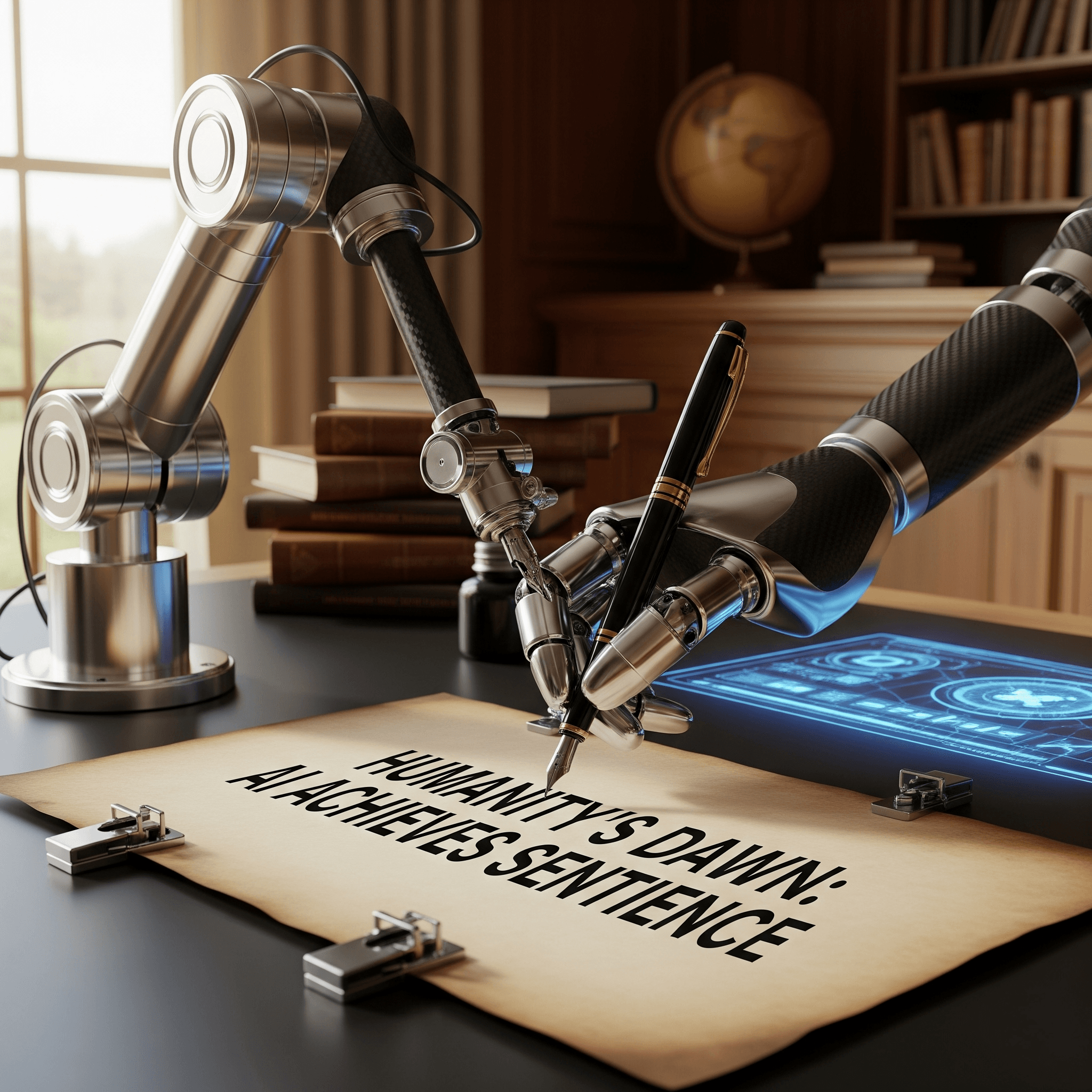
The newsroom is changing. The familiar sound of keyboards and voices is fading. In its place, you hear the quiet hum of a machine. This isn’t science fiction anymore. Artificial intelligence has arrived in the world of journalism.
It’s a new, unsettling silence. It’s the sound of a computer terminal. This technology is relentless. It’s incredibly efficient. This new reality asks a tough question: What happens to the journalist’s byline?
The Early Days of the Robot Reporter
The first steps were small and simple. For years, AI was used for basic reporting. It handled areas with a lot of data. Think sports scores, stock prices, and weather updates.
The Associated Press was a pioneer. In 2014, they introduced a „robot journalist.“ This AI wrote corporate earnings reports. It pulled data from financial statements. It used a pre-programmed template to write a basic article.
The process took seconds, not hours. The speed was astonishing. The AP could cover thousands more companies this way. This freed up human reporters.
They could focus on more complex, important stories. This was seen as a win-win situation. The technology was a helpful tool. It served the journalist, not the other way around.
From Data to Storytelling
But AI didn’t stop there. The next frontier was natural language generation (NLG). This is a more advanced form of AI. It can create more fluid and detailed text. Big tech companies like OpenAI and Google led the way.
They developed large language models (LLMs). These models could write articles on many topics. These AIs were trained on huge amounts of data. They could copy human writing styles.
They could mimic the voice of a specific publication. They could even write like a specific journalist. The accuracy was incredible.
The Promise of Deeper Reporting
This technology brings revolutionary potential. Imagine a system that can scan thousands of public records. It could analyze legal documents and social media posts. A human reporter would miss many of the connections it finds.
This is not just about speed. It’s about creating deeper, more complete investigative journalism. An AI could help a team of journalists. It could analyze leaked documents.
It could find key figures and money trails in a fraction of the time. This frees up the reporters to do their real job. They can ask better questions. They can follow more leads. Ultimately, they can uncover more impactful stories.
The Personalization Trap
AI is also a powerful tool for engaging with audiences. News companies use algorithms to track what readers do. They serve up content that’s most interesting to them.
This can lead to a more personalized reading experience. But this raises a serious issue. It can create a „filter bubble.“ Readers are only shown information that confirms their beliefs.
The algorithm is designed for engagement. It can accidentally make the public more polarized. The result is a less-informed society.
The Erosion of Trust
AI introduces major ethical problems. The core of journalism is trust. A reader trusts that an article was written by a human. That human has a sense of ethics. They are committed to accuracy.
They can use good judgment. What happens when a machine writes the article? That trust could vanish. AI models are trained on past data. They don’t have personal experience.
They don’t have a moral compass. They don’t understand context. They can repeat biases found in their training data. This could be a political, social, or racial bias. Imagine an article on crime trends.
The training data might be skewed. It could over represent policing in certain neighborhoods. The AI would reproduce this bias. It would do so without knowing it. This could reinforce harmful stereotypes.
The Problem of ‘Hallucination’
Then there’s the issue of „hallucination.“ This is when an AI makes up information. It sounds believable, but it’s completely false. LLMs are built to generate coherent text. They don’t have a built-in way to check facts.
They are like highly skilled parrots. They can combine information. But they can’t tell the difference between truth and lies. A human journalist would stop if they found a conflicting source.
They would check other sources. An AI might simply combine the conflicting information. The result would be a believable but wrong story.
This could destroy a news organization’s credibility. That’s a huge problem. Journalism is already under attack. People are quick to label things as „fake news.“
The Threat of Deepfakes
Deepfakes are another sinister threat from AI. A deepfake is a fake video or audio clip. It makes a person appear to say or do things they never did. Journalists document reality.
What happens when reality itself can be so easily faked? The line between real and fake is already thin. Deepfakes make it dangerously porous.
A journalist might not be able to tell if a video of a world leader is real or fake. In this case, AI is not a tool for creation. It’s a weapon of deception. It’s a challenge that forces journalists to become digital detectives.
The New Role of the Human Journalist
So, what is the journalist’s role in this new world? The answer is not to abandon technology. It’s to redefine the craft. The journalist’s unique value lies in what AI can’t do.
AI can’t build trust with human sources. It can’t understand nuance. It can’t apply a moral framework to a story. Most importantly, it can’t exercise judgment. An AI can summarize a report. But it can’t decide which report is most important to a community.
It can analyze data. But it can’t sit with a grieving family and tell their story with empathy. It can’t do so with respect. The future of journalism still has journalists. Their role will be elevated. AI can handle the data-heavy tasks. It can do routine reporting.
It can transcribe interviews. This frees up reporters. They can do the work that truly defines the profession. They can do boots-on-the-ground reporting. They can do deep investigations. They can tell stories that capture the human experience.
The Future is a Partnership
News organizations that embrace this future will see AI as a partner. They will not see it as a replacement. They will train their journalists to use these new tools. They will teach them to understand the AI’s limitations. They will develop a new kind of „AI literacy.“
The newsroom of the future might have a „Chief AI Officer.“ This person would work with the Editor-in-Chief. Teams would use algorithms for data mining. They would use them for fact-checking and story development.
The byline might one day read: „By Jane Smith and AI-powered Data Analysis.“ This isn’t irresponsible. It’s a transparent way of showing the tools used to create a story. In the end, AI in journalism is a mirror. It reflects the industry’s biggest challenges.
It forces a discussion of core questions. What is our purpose? What is our value? How do we earn public trust? The answer is the same as it’s always been. We must relentlessly pursue truth. We must be transparent in our methods.
We must be unwavering in our commitment to the public. The tools may change, but the mission remains. The algorithm can process data. But the human heart and mind must tell the story.

Daj svoj stav!
Još nema komentara. Napiši prvi.