


By Brian Ochieng Akoko, Reporter | Nakuru City – Kenya.
The border between Cambodia and Thailand is once again a flashpoint. Clashes in May and July 2025 have become the deadliest in over a decade.
The fighting has displaced hundreds of thousands of people and exposed old, deep-seated issues. A tense ceasefire is in place. But the conflict’s root causes have not been solved.
These include unresolved borders, strong national pride, and a lack of trust. This cycle of violence may be far from over.
History’s Unresolved Echoes
The conflict’s origins are in colonial-era treaties from the early 1900s. These treaties left large parts of the border unclear. This ambiguity has led to repeated clashes.
The ancient Preah Vihear temple is a key point of contention. The International Court of Justice (ICJ) ruled in 1962 that the temple belonged to Cambodia.
But the issue was reignited in 2008 when Cambodia tried to make it a UNESCO World Heritage site. In 2013, the ICJ reaffirmed Cambodia’s sovereignty over the temple. However, it left the status of nearby areas unresolved.
This shows that legal rulings alone cannot solve a conflict built on national pride. The fighting has also spread to other temples and strategic areas along the border.
A Timeline of Escalation: From Skirmish to Full-Scale Conflict
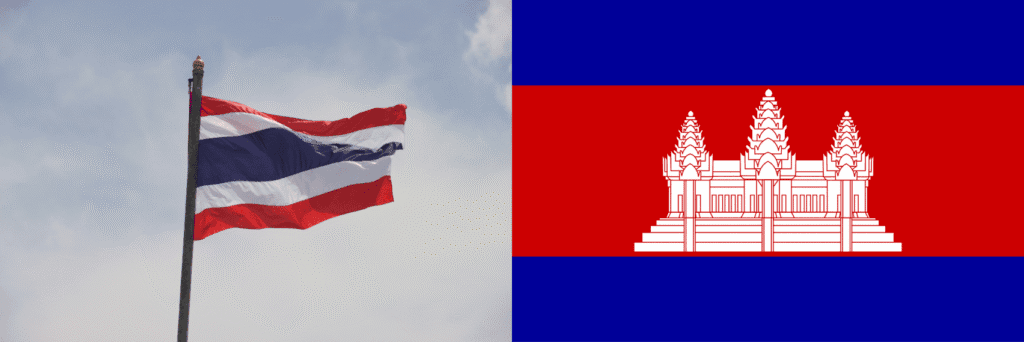
The 2025 conflict escalated quickly. It began with minor incidents and built up to full-scale fighting.
- February 13: Tensions start at the Prasat Ta Muen Thom temple.
- May 28: A deadly skirmish in the Emerald Triangle kills a Cambodian soldier. Both sides blame the other.
- June 5: Bilateral talks collapse. Thailand reinforces its military presence.
- June 15: Cambodia appeals to the ICJ and imposes diplomatic sanctions.
- July 16 & 23: Landmine incidents injure Thai soldiers, providing a trigger for a major confrontation.
- July 24: Full-scale armed conflict erupts. Thailand launches airstrikes.July 25: The UN Security Council holds an emergency meeting.
- July 28: A ceasefire is brokered in Malaysia. The United States uses economic pressure to facilitate the truce.
- July 29: Ceasefire breaches are reported. Thailand captures 20 Cambodian soldiers.
- August 4: Leaders meet for talks. Cambodia’s King issues a decree to strengthen military control under former leader Hun Sen.
Each side uses this timeline to justify their actions. This „blame game“ complicates efforts for a real resolution.
Casualties and Displacement
The fighting has had a terrible human cost. Between 35 and 41 people, including soldiers and civilians, were killed.
More than 260,000 people were forced to leave their homes on both sides of the border. The displacement has created a serious humanitarian crisis.
Even with the ceasefire, the danger from unexploded ordnance remains. This poses a long-term threat to communities, especially to children and farmers.
Conflicting Narratives and International Law
Both countries have launched a „propaganda front.“ Each side blames the other for starting the conflict and for violating international law.
Cambodia claims Thailand launched „unprovoked“ attacks. It accuses Thailand of using illegal cluster munitions and „toxic smoke.“
Thailand says Cambodian soldiers fired first. It denies using illegal weapons and labels Cambodia’s claims as „fake news.“
These conflicting accounts make it difficult to find the truth and establish accountability.
ICJ vs. Bilateral Diplomacy
A major point of disagreement is how to resolve the conflict.
Cambodia wants international help through the ICJ. It believes this will level the playing field against a militarily stronger Thailand.
Thailand wants to use direct, bilateral talks. It prefers to handle the dispute without outside intervention.
The Fragility of the Truce
The current ceasefire is a tactical pause, not a lasting solution. It was achieved mainly due to economic pressure from the United States.
The truce is already fragile. Breaches were reported just one day after it took effect. Thailand’s decision to call captured soldiers „prisoners of war“ suggests it views the situation as a formal conflict.
This could make it harder to find an official end to the hostilities.
The Role of Nationalism
The border dispute is tied to domestic politics in both countries. In Thailand, the conflict caused political turmoil and a loss of public trust in the government.
This has boosted the military’s influence. In Cambodia, the conflict has allowed former leader Hun Sen to maintain power.
The government has used nationalist sentiment to gain public support. This makes it politically difficult for Cambodia’s leaders to compromise on territorial issues.
Nationalism and Leadership
The border conflict is deeply intertwined with domestic political dynamics in both countries. In Thailand, the conflict has generated significant political turmoil.
Prime Minister Paetongtarn Shinawatra was suspended from office, and her government’s perceived „softness toward Cambodia“ led to a key coalition partner withdrawing its support.
In a recent poll, a majority of Thais expressed no confidence in their government’s ability to manage the conflict. A staggering 62.52% expressed high trust in the military to resolve the dispute.
This suggests that the military, with its high public trust, may be in a position to exert greater influence over foreign policy and favor more assertive, bilateral approaches.
In Cambodia, the conflict has seen former leader Hun Sen maintain a high profile, actively criticizing Thailand. King Norodom Sihamoni’s royal decree, authorizing Hun Sen to guide military and national defense affairs alongside his son, Prime Minister Hun Manet, is a remarkable development.
The decree, which cited „threats to its territorial integrity by the Thai soldiers,“ appears to be a direct response to suggestions that Hun Sen was undermining his son’s authority.
This move suggests that the Cambodian government has successfully mobilized nationalist sentiment to consolidate power.
Public opinion surveys show overwhelming satisfaction with the government’s handling of the conflict. A toll of 99.8% supporting resolution through the ICJ, and over 95% backing the Royal Cambodian Armed Forces.
This strong domestic backing empowers the Cambodian leadership to maintain its firm stance on international adjudication. This makes any compromise on territorial issues politically challenging.
The Path to Lasting Peace
The Cambodia-Thailand border conflict, reignited in 2025, is a vivid and deadly illustration of a cycle of historical grievances, clashing diplomacies, and domestic political imperatives. The current ceasefire, while a welcome pause in the bloodshed, is inherently fragile.
Without a genuine willingness from both sides to address the root causes of the dispute through a mutually acceptable framework, and to build trust through transparent mechanisms for fact-finding and accountability, the cycle of conflict and dormancy is likely to persist.
The involvement of external powers like the U.S. and China underscores the regional and international implications of this conflict, suggesting that sustained peace will require continued international engagement.
However, the path forward will not be easy. It requires both nations to move beyond the „propaganda front“ and engage in a shared commitment to a lasting, comprehensive resolution.
The resolution should acknowledge both the historical context, and the profound human cost of their unresolved dispute.
Only then can the communities living along this troubled border hope for genuine and lasting peace.

Daj svoj stav!
Još nema komentara. Napiši prvi.