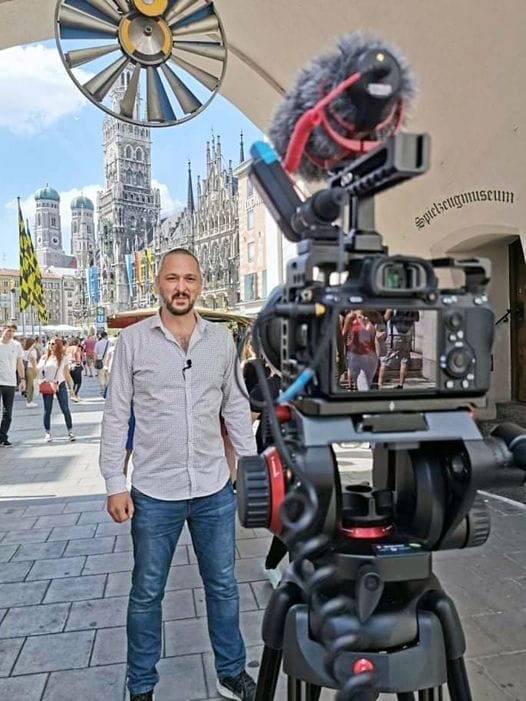
Diplomatic International Journalist
editor at digital magazine
rEUconnection – REUC
Vjosa Çerkini is a journalist and documentary filmmaker from Pristina, Kosovo, known for her investigative work across the Western Balkans and internationally. Her reporting spans topics such as organized crime, politics, social justice, and human rights, with a focus on Kosovo, Albania, Montenegro, and neighboring regions.
Film Work and Recognition
- She is the author of the award-winning documentary Working Today, Only for Tomorrow, selected as Documentary of the Year (2021) by the Association of Journalists of Kosovo.
- The film highlights the discrimination faced by middle-aged women in the labor market.
- In 2023, her investigative work on call-center frauds was ranked among the Top 10 Investigative Stories in Europe by Investigative Journalism Europe.
Journalism Career
- Çerkini reports for leading international media outlets such as Deutsche Welle, MDR, BR, dpa, as well as regional media across the Balkans.
- Her reporting covers femicide, war crimes, cyber violence, discrimination, and transitional justice.
- Through her journalism, she seeks to break negative Western stereotypes about the Balkans.
International Engagement
- She serves as the European representative of Women’s Voices Now, a Los Angeles–based organization promoting women in journalism and documentary filmmaking.
- She conducts free global workshops and offers year-long mentorship to young women in Africa, Europe, and beyond.
- Using donations from her journalism and film awards, she supports girls financially as they produce their first films.
- Çerkini has also worked in Germany, including with Bayerischer Rundfunk and the German government’s Press and Information Office.

Interview
Journalist: Your documentaries tackle complex societal and political issues. What inspired you to choose filmmaking as your medium for addressing these topics?
Vjosa Çerkini: From uncovering some of the biggest financial frauds in Europe to investigating human and animal trafficking networks, and reporting from the frontlines of the clashes in northern Kosovo I’ve always been driven by a deep urge to expose the truth. As an investigative journalist, I realized that written articles can inform, but visual storytelling can move people in a deeper, more visceral way. Documentary filmmaking gives me the power to combine evidence-based research with human emotion. It lets me bring the viewer directly into the lives of those affected whether it’s a girl sold into trafficking, a family trapped by organized crime, or a community torn apart by political violence. These aren’t just statistics or headlines. They’re real people with real stories that deserve to be seen and heard.
For me, film is not just a medium it’s a responsibility. I use it to amplify voices silenced by fear, to challenge systems built on injustice, and to give context to the chaos. When people watch my documentaries, I don’t want them to just understand the problem. I want them to feel it and be moved to care.
Journalist: In „Boxing with Politics,“ you explore how politics influences the lives of athletes. What was the most challenging aspect of capturing this story?
Vjosa Çerkini: „In „Boxing with Politics“, we shared the story of Donjeta Sadiku, a talented boxing champion who was denied the chance to compete in world championships simply because she is from Kosovo. The documentary reveals how political barriers and discrimination overshadow the dreams and achievements of athletes like Donjeta. It’s a powerful look at the challenges Kosovars face on the international stage, where talent alone isn’t always enough to break through.
It was challenging to bring together boxing legends like the former Yugoslav Olympic champion Aziz Salihu and the former world boxing champion based in Germany, Robin Krasniqi, in one film. But in the end, we succeeded in becoming the voice of the people worldwide. I’m really proud that this film has been recognized among the top documentaries in the world this year, showing that these important stories are finally receiving the attention they deserve.„

Journlilst: What are some of the unique challenges you’ve faced while reporting on politically sensitive topics?
Vjosa Çerkini: „One of the unique challenges I’ve faced is that, as an ethnic Albanian reporting for international media, my work can sometimes be viewed with suspicion or difficulty when I report from Serbia. There are moments when my identity adds an extra layer of complexity, especially on politically sensitive topics where tensions run high.
However, despite these challenges, I truly love working across the Balkans. My goal is to raise the voices of people wherever they are—whether in Kosovo, Serbia, or beyond—and to tell stories that might otherwise be overlooked. Navigating these sensitive environments requires care, respect, and persistence, but it’s also incredibly rewarding because it allows me to bring attention to important issues and foster greater understanding in the region.„
Journalist: Your documentary ‘Boxing with Politics’ has received critical acclaim and won prestigious awards. What impact do you feel this recognition will have on raising awareness about the challenges faced by athletes like Donjeta Sadiku, and how has the film’s success influenced your approach to future projects?
Vjosa Çerkini: „I feel truly honored and grateful for the recognition Boxing with Politics has received. This acknowledgment helps bring important attention to the challenges faced by athletes like Donjeta Sadiku, whose stories often go unnoticed. It means a lot to know that the film is helping to raise awareness about the political and social barriers these athletes face.
The success of the documentary also inspires me to continue working thoughtfully and passionately on future projects. It reminds me how powerful storytelling can be in giving voice to those who are often overlooked, and it motivates me to keep telling stories that matter with honesty and respect.„
Journalist: Your work is world wide recognized, and you are working on different projects. How do you manage to multitask what journalists need to do to have the best organization for that kind of engagement?
Vjosa Çerkini: „First of all you should love your work very much. Your dedication should be strong. Managing multiple projects across different continents requires careful organization, discipline, and a strong support network. As a journalist and filmmaker working worldwide—from Europe to Africa and beyond—I prioritize clear planning and setting realistic goals for each project. I break down large tasks into smaller, manageable steps and use tools like calendars and project management apps to keep track of deadlines and commitments. Flexibility is essential because news and circumstances can change rapidly across different regions. I stay adaptable and open to shifting priorities without losing focus on the bigger picture. Collaboration is also key—working with trusted teams and local contacts on every continent helps me gather information efficiently and maintain quality across projects. Ultimately, balancing multitasking comes down to passion for the work, staying organized, and always remembering the importance of the stories I’m telling.“

Journalist: Are there any upcoming projects or areas of focus that you’re particularly excited about?
Vjosa Çerkini: Yes, I’m very excited about several projects underway this year. I’m conducting major investigations across Europe focusing on crimes, wars, and complex social issues, stories that are urgent and need greater visibility. At the same time, I’m also finalizing the first documentary films created by my students from diverse countries like Nigeria, Poland, Germany, and Kosovo.
It’s incredibly rewarding to see these young filmmakers’ voices emerge and to support their work alongside my own investigations. This blend of deep investigative reporting and empowering the next generation through storytelling is what drives me. I’m looking forward to sharing these stories and continuing to highlight important issues on both a personal and global level. I’m also working on my first film for the American market together with my colleague Jack Belisle from New York.“

Journalist: How do you see the role of journalism evolving in the Balkans in the next few years?
Vjosa Çerkini: Journalism is absolutely essential in the Balkans, especially now as the region continues to face political, social, and economic challenges. I believe the role of journalism will only grow stronger in the next few years, as more people demand transparency, accountability, and truthful storytelling. I have always been inspired by journalists from the region like Idro Seferi, who show courage and dedication in their work despite difficult circumstances. At the same time, I’ve looked up to international journalists such as Richard C. Schneider and Fanny Facsar for their professionalism and commitment to high-quality reporting.
The future of journalism in the Balkans depends on building bridges between local and international perspectives, supporting young journalists, and embracing new technologies and platforms to reach wider audiences. I’m hopeful that journalism will continue to be a vital force for positive change and understanding in the region.
Journalist: Overall, you are empowering young women in which category, and what kind of results do you have in this commitment?
Vjosa Çerkini: „Yes, as the European representative of Women’s Voices Now in Los Angeles, I empower young women in journalism and documentary filmmaking. I organize free workshops around the world — from Africa to Europe and beyond — and mentor girls for a full year to help them create their first films.
With the donations I receive from my journalism and film awards, I also support them financially. I love this work, and I love every single girl I’ve mentored. We’re already building an empire of strong girls and powerful women’s voices — and this is just the beginning.„
Journalist: You were awarded as the Media Champion of Trustbuilding in 2025 for your work between Albanians and Serbs. How do you feel about receiving this recognition?
Vjosa Çerkini: „It truly means a lot to me. Trust is something fragile in the Balkans, especially between Albanians and Serbs, and building it takes time, courage, and deep listening. As someone who grew up during the war and now works across the region, I know how powerful stories can be in breaking down walls and bringing people closer.
This award isn’t just about me, it’s about every person who dared to speak, to open up, and to listen. I feel honored and even more motivated to continue creating space for truth, dialogue, and understanding. We need more connection in this region, and journalism can be a bridge. I dedicate this award to both Albanians and Serbs — to the people on both sides who believe in peace, dialogue, and truth. This recognition is not just mine; it belongs to every voice that’s been silenced, every story that needed to be heard.„
Journalist: What will be the message to the young journalists who are watching your work?
Vjosa Çerkini: Journalism is one of the most noble professions a person can have, and I feel incredibly grateful to be doing this work.
Vjosa Çerkini: „To all the young journalists watching: fight for the truth, stand up for people, and use your voice to challenge injustice. That’s how we create a better, more just society together. Never forget the impact your words and your stories can have.„
Note: Documentary „Boxing with politics“ you can find here.
Daj svoj stav!
Još nema komentara. Napiši prvi.